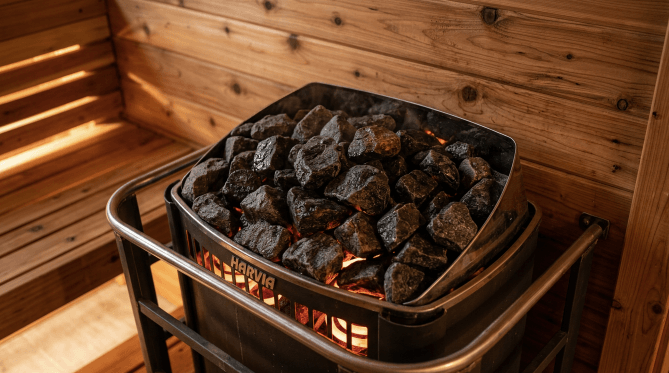
A household sauna heater needs three things a single-user unit doesn’t: enough capacity for the number of people who’ll realistically use it at once, a thermostat range wide enough to satisfy different heat preferences, and simple enough controls that everyone in the house can operate it safely. Most families do well with a 6kW to 9kW electric heater sized to a three- or four-person cabin, run at a moderate 160 to 175°F as a default rather than the higher end some individual users prefer.
How Do You Size a Heater for a Family Instead of One Person?
Sizing still starts with cubic footage, but a household cabin is usually larger than a solo one, often in the 250 to 350 cubic foot range for three to four people seated. That points toward a 7kW to 9kW electric heater rather than the 4.5kW to 6kW units common in small personal cabins. Undersizing is a bigger problem in a household setting than a solo one, since a heater that struggles to keep up gets worse the more the door opens and closes as different family members come and go during a session.
What Temperature Range Actually Works for Mixed Preferences?
Rather than settling on one fixed temperature, look for a heater with a thermostat that adjusts comfortably across a wide band, typically 100 to 190°F on quality residential units. A practical household default is 160 to 175°F, hot enough to feel like a real sauna session but not so extreme that less heat-tolerant family members, often kids, older adults, or first-timers, are uncomfortable within a few minutes. Anyone wanting a hotter, more intense session can raise the setting for their own turn.
Should a Family Sauna Be Electric or Wood-Fired?
Electric heaters are generally the more practical choice for households, mainly because of convenience. Anyone can set a target temperature and let the thermostat handle the rest, with no fire to tend and no risk of someone leaving an open flame unattended. Wood-fired heaters have real appeal, a different quality of heat and no electric bill, but they require active management that doesn’t fit well with a household where different people want to use the sauna at different times without coordinating who’s tending the fire.
Is Infrared a Better Fit for Households With Kids or Lower Heat Tolerance?
It can be. Infrared cabins run at 120 to 150°F rather than the 170 to 190°F of a traditional heater, since infrared panels heat bodies directly rather than superheating the surrounding air. Some families find this a gentler entry point for kids, teenagers, or anyone with lower heat tolerance, while still getting a genuine sweat session. The tradeoff is that infrared doesn’t replicate the classic steam-on-stones sauna experience, so a household that wants the option of both intense heat and a gentler alternative sometimes ends up considering two smaller units rather than one shared cabin.
See also: The Future of Social Networking
How Many People Can a Family-Sized Heater Actually Support?
A heater and cabin rated for four adults is sized assuming four seated people, and comfort drops noticeably if you regularly exceed that number, since more bodies in the room affect how evenly heat distributes and how quickly the space cools each time the door opens. If your household regularly has more than four people wanting to use the sauna together, sizing up to a larger cabin and a correspondingly bigger heater, or planning for smaller staggered sessions, both work better than squeezing extra people into an undersized space.
What Safety Features Matter Most for a Household Setting?
A secure, properly installed guard rail is non-negotiable when kids or teenagers have access to the sauna. Simple, clearly labeled thermostat controls reduce the chance of someone accidentally setting an unsafe temperature. Some households also add a heater with a built-in timer or auto shut-off, so the unit can’t run for hours unattended if someone forgets to turn it off after their session. None of these are exotic features; most mid-range residential heaters include them standard, but it’s worth confirming before buying rather than assuming.
What About Households With Older Adults?
Older adults sometimes have lower heat tolerance or take medications that affect blood pressure regulation, both of which matter for sauna use. A wide, easy-to-read thermostat display and a lower default temperature setting, closer to 150 to 160°F, make sessions more approachable without eliminating the benefit entirely. A bench low enough to sit on without difficulty and a sturdy handrail near the door also matter more in a multi-generation household than in a single-user setup. None of this requires a different type of heater, just attention to defaults and layout when the cabin is built or the controls are set up for daily use.
What Should You Compare Before Buying for a Household?
Look at kW rating against your cabin’s actual cubic footage, thermostat range, whether the control panel is simple enough for every household member to use confidently, and whether the heater includes a timer or auto shut-off. If you’re comparing multiple models, https://sweatdecks.com lists spec sheets for several household-sized heaters side by side, which makes it easier to check these details before committing to a wiring plan and cabin build.
Frequently Asked Questions
What size heater works best for a household with different heat tolerances? A heater sized correctly for the cabin’s volume with a wide, easy-to-adjust thermostat range, roughly 100 to 190°F, lets each household member set their own preferred temperature per session.
Should a family sauna be electric or wood-fired? Electric is usually more practical for households where different people use the sauna at different times, since it reaches a set temperature automatically without someone tending a fire.
Is an infrared heater a good choice for a household with kids? Infrared cabins run at lower peak temperatures, typically 120 to 150°F, which some families find more comfortable for teenagers or less heat-tolerant members, though it’s a different experience than a traditional high-heat sauna.
How many people can realistically use a sauna heater sized for four? A heater rated for four adults is sized for the room’s volume with everyone seated, but comfort drops once you exceed that number, since more bodies in the space slow how evenly the room heats and cools.
Does a household sauna heater need special safety features with children around? A secure guard rail and a thermostat with clear, simple controls matter most. Some households also add a timer function so the heater cannot be left running unattended for hours.
References
- “Benefits and Risks of Sauna Bathing.” The American Journal of Medicine, 2001. https://pubmed.ncbi.nlm.nih.gov/11165553/
- Hussain, J. N., et al. “Does the Combination of Finnish Sauna Bathing and Other Lifestyle Factors Confer Additional Health Benefits? A Review of the Evidence.” Mayo Clinic Proceedings, 2023. https://pubmed.ncbi.nlm.nih.gov/37270272/
- Hannuksela, M. L., Ellahham, S. “Effects of Heat and Cold on Health, With Special Reference to Finnish Sauna Bathing.” American Journal of Physiology – Regulatory, Integrative and Comparative Physiology, 2018. https://pubmed.ncbi.nlm.nih.gov/29351426/
- Harvard Health Publishing. “Saunas and Your Health.” https://www.health.harvard.edu/staying-healthy/saunas-and-your-health
By Colin Baxter